Showing posts with label Italy. Show all posts

Friday, 28 August 2015

Apulian Stories - Grotte di Castellana

A short drive inland from the coast near Monopoli are the Grotte di Castellana - the largest grotto system in Italy. It is an amazing underground landscape, 60 m down and full of stalagmites and stalaktites , very well lit and presented and certainly worth a visit, although we were reluctant at first to leave the light and warmth to go underground to a freezing 16 °C. 
Unfortunately, photography was only allowed in the first cave ... hard to understand in the era of social media, why anyone would voluntarily miss out on the free publicity by visitors' pictures. 


the entrance cave has natural light


detail

Thursday, 27 August 2015

Apulian Stories - Monopoli, Polignano and other villages on the coast

Near Egnazia on the coast are several attractive little fishing villages worth a visit.


Monopoli 

spectators waiting for the fireworks on the evening of Ferragosto


a large fishing fleet


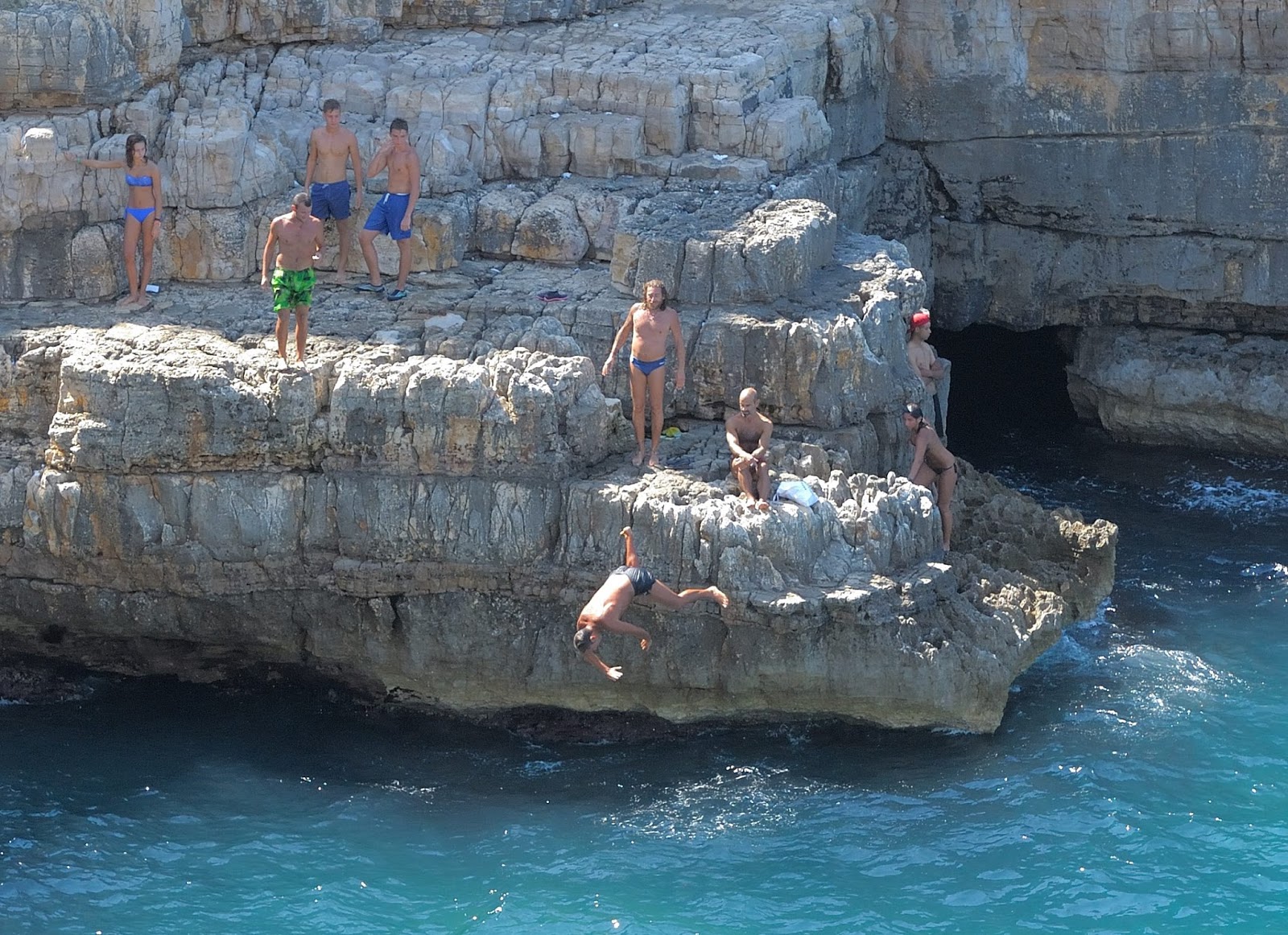
Polignano al Mare is famous for its cliff in the middle of the town, where daredevil swimmers find natural jumping boards from all heights, that invite to dive into the pristine turquoise waters off the beach. 


- not in Venice - 


There are several nice fish restaurants. You can relax and have an excellent meal on the terrace  clinging to the rock with a nice view of the swimmers down in the bay until late in the evening. 


Trani is a sleepy fishing village with an oversized cathedral on the water...


and red and green lighthouses marking the entrance to the harbour. 


A lighthouse on the coast further south in Torre Canne


Storm clouds gathering

Monday, 24 August 2015

Apulian stories - Egnazia

I found this page of a school book, arranged and framed on a wall. It is a fitting start for my Apulian photo series!


Apulian history goes back a long long time. Apulia was colonized by many different cultures, the Greeks, the Romans, the Arabs, the Normans, the Staufer with Kaiser Friedrich II... all left their mark on the land with their buildings, food and artisanship. 
The old Greek city of Egnazia lies on the Italian adriatic coast north of Brindisi. It was first settled in the Bronze ages, colonized by the Greeks and in the 4th century BC became a Roman town with city walls, amphitheater, thermal baths and a large forum. Today, only ruins are left. 


the amphitheatre

The Via Traiana was built around 100 AD  from Beneventum to Brindisi - the latter was the major roman harbour for trade with the eastern mediterranean - as a coastal alternative to the Via Appia which led from Rome to Tarent. It leads right through the town centre of Egnazia and is paved with large lime slabs where the ruts left by chariot wheels can still be seen. 


A "cryptoportico" was excavated: an underground corridor with four arms and light wells, possibly around a structure used for rainwater harvesting or cool storage of food supplies in the hot climate.


entrance to the cryptoportico

 no one in there, just a lonely rat ...


Part of the thermal baths with hypocaustic heating: 


 Next to the thermal complex, to the left, was the Forum, a large open space, now used as a zucchini field ....


Behind this field, towards the sea, lies the old harbour, nowadays cut off by a new road and not accessible from the archaeological site. The town was gradually abandoned from the 6th century on, when the vandals roamed the country. The large harbour is now submerged - either due to rising water leves or the sinking of the land mass, I could not find out . The old city wall can still be seen leading into the water, and divers (my oldest son does scuba diving) can find remnant harbour structures overgrown by algae just off the coast in a depth of a few meters only - sorry, I hate to get my head underwater, so no pictures here! 


There is still so much to be found and excavated and protected ... and who knows what lies beneath this mound and how many Roman or Greek slaves moved those stones through the centuries? 


Sunday, 16 August 2015

Il Palio di Siena


These are pictures from a visit to the Palio, the twice-yearly horse race on the Piazza del Campo in the centre of Siena in Tuscany, which takes place todayThe whole town is involved in this event, which is a competition between the 17 different contradas  (quarters) of the town. We watched the palio, when we took a vacation in Florence a couple of years ago, and went over to Siena for the day and the evening of the race.


The Duomo in Siena is decorated with flags of the Contrade.


The symbols of the different houses do not always depict the fastest animals ...


It is a long afternoon until the race finally starts after sundown. Before the race, in the different quarters of the town, horses are led to the local churches and receive a blessing amid the crowds. Ballots are drawn to assign horses to the contradas. The jockeys are mostly external hired professionals. 


Seats on the piazza are leaning rather precariously against the old buildings.


 The piazza has been prepared with loamy sand for the horses and dangerous curves have been upholstered . 


Before the race, the contrades parade with costumes, the horses are shown around , flagbearers show their artistry. Four white bulls pull the carriage with the honoraries and the banner, the palio, for the winner ...


This horse is not too happy ...


and needs some caresses by his owner.


The race finally starts around sun-down. 


They start the race with a pistol shot and two simple ropes - therefore we had a couple of false starts and the race took place in the dark which led to rather grainy photographs. The whole group races three times around the piazza. 


First man down.


Second man down.


Horses continue even without rider. 


The race lasts no more than 2 minutes. The horse, that crosses the finishing line first, wins - even if it has lost its rider before. A great tribute to the abilities of the horses! Many horses lose their riders on this tight course - and as they ride without saddles, it takes quite some skill to stay on top. 


The Winner: the Owl! 


The race is over. 


Good Luck!