Thursday, 21 June 2018

Starting a new garden


I have been neglecting this blog for the past months, not only for a lack of travel and ideas, but also because of little spare time. The semi-retirement of my husband last autumn has not only changed his daily routines but also affected mine.  
One outcome is that we decided to look for a second home in warmer parts of Europe. To follow the birds when winter comes and escape to warmer climates had been a life-long dream of mine, climbing on the back of a strong bird and fly south in November to return in April. So literally and in spirit, in winter this year we followed the cranes and storks on their route south towards Gibraltar and found close-by and on this side of the water: Andalucia!  


shot from the plane window shortly before landing in Málaga

Why Andalucia? It is a beautiful land, with a history of civilizations going back to Europe's foundations. It provides connectedness to our heritage. It has mountains and valleys, as you can see above, natural parks, a long sea shore on the Mediterranean Sea, excellent weather with no frost in winter with the possibility to make a great garden, perfect infrastructure for second homes, airports, motorways, good food, a love of music, and last but not least: the local people love horses! 

We flew over five times in the past months and finally found a place, an old house in a huge garden, to be renovated, with lots of charming crazy details:


... this beautiful door leads nowhere ...


but has a functioning intercom system: 


The view is perfect: 


And two little but significant details convinced me that this was the right place to be happy:


Its huge garden has many old olive trees and beneath the olive trees grows sprawling one of my tiny favourites: the white and pink mexican daisy Erigeron karvinskianus ! Lots and lots of them! 


And the name of the house is: 


I started to learn Spanish ... 

Hasta luego! 


Thursday, 26 April 2018

Visit : Around Berlin - Schwanenwerder on Wannsee


"Wannsee, Wannsee  - Wann seh ich dich endlich wieder?" goes the text of a song currently in the German pop charts  by the music group "Die Toten Hosen" evoking summer feelings and refreshing dives into this famous lake on the outskirts of Berlin. Famous for its water sports within the boundaries of the city of Berlin and also infamous for its connections in history.

I recently reread a book from one of my favourite authors Robert Harris : "Fatherland", a gripping novel and thriller set in the unusual backdrop of a Nazi-Germany in the 1950s and 60s assuming the Germans had won the war. The first murder victim  is found on Schwanenwerder,  a peninsula which protrudes into Wannsee. 
And as this whole area around Potsdam with its many lakes, castles and beautiful spots  is our favourite place to visit on weekends in Berlin, we decided to have a look what it was all about... 


Schwanenwerder, "Swan's Ait", is a settlement of villas and mansions,  built by wealthy industrialists at the end of the 19th to the beginning of the 20th century to contrast the royal Pfaueninsel, "Peacocks' Island", close-by with its summer palaces of the Prussian kings. The residential very large plots reach down to the beaches of Wannsee with some old villas still left untouched and dilapidated, some renovated and in new ownership.

a boat house


Permanent exposition boards explain the history of Schwanenwerder, the villas and their inhabitants, and  their roles in the history of Nazi-Germany. 


Across the lake a large mansion can be seen: the House of the Wannsee-Conference, now a memorial and educational site, with an extensive exhibition about the Holocaust. It plays a central role in Robert Harris's book. 


The gardens are beautiful and lead down to the water. Who would have thought that in such beautiful surroundings such atrocious plans could be devised and discussed? 


the view across Wannsee from the garden

Boats on Wannsee in an artistic impression


"Abendstimmung"


Wednesday, 14 March 2018

Visit : A Rainy Week on the Costa del Sol

The rain in Spain falls mainly ... in Andalucia! 

Last week we were retracing steps made thirty years ago when we had visited Costa del Sol, the sunny coast in the south of Spain. We remembered a terrible and surprisingly cold weather then, we had to buy long-sleeved sweaters as we came wholly unprepared during May 1988  - but now we had the weather apps and were forewarned. Though Costa del Sol and the area around Marbella claim 320 sunny days per year, we always seem to be there during the remaining few days of rain and clouds. Friends living there praised the rain that we apparently brought with us - they had been waiting for months for a drop on the parched soil. Apparently, the downpours during our stay filled the reservoirs up in the mountains that supply water for the cities down on the coast up to the brim and would last for two or three years now. 


Málaga


It is raining but at least it is warm. Fountains don't have to be emptied for winter.


for better days


the view from the old fort Alcazaba towards Malaga harbour

On a rainy day the Museo Carmen Thyssen is worth a visit with Spanish scenes from the 19th and early 20th century ... 


The Church of the Sainted Martyrs (Iglesia de Los Santos Martires) is in the old town with interesting ceramic tiles on the outside and a very rococo interior. 


A trip to Gibraltar ... can you make out the apes' rock? The high winds were so gusty from the Atlantic, we decided to stay in the car...


The old town of Granada is only a 90 min drive from the coast up into the mountains. Our visit to Alhambra had been booked months ahead, so we were not flexible as entrance is strictly limited to  a specific time.  

a selection of umbrella designs on a walk through the Generalife, the summer palace of the rulers of Alhambra


I realized the merits of those strange plasticky transparent umbrellas that the hotel gave us: there are no limits to the view into the rain and whatever can be detected behind the curtain of falling raindrops. One can even take pictures through or below...


the winter view from Generalife to Alhambra


oranges and almonds


 an old aquaeduct for watering the gardens


A short break : Visiting in bad weather has the distinct advantage of fewer tourists in the picture.

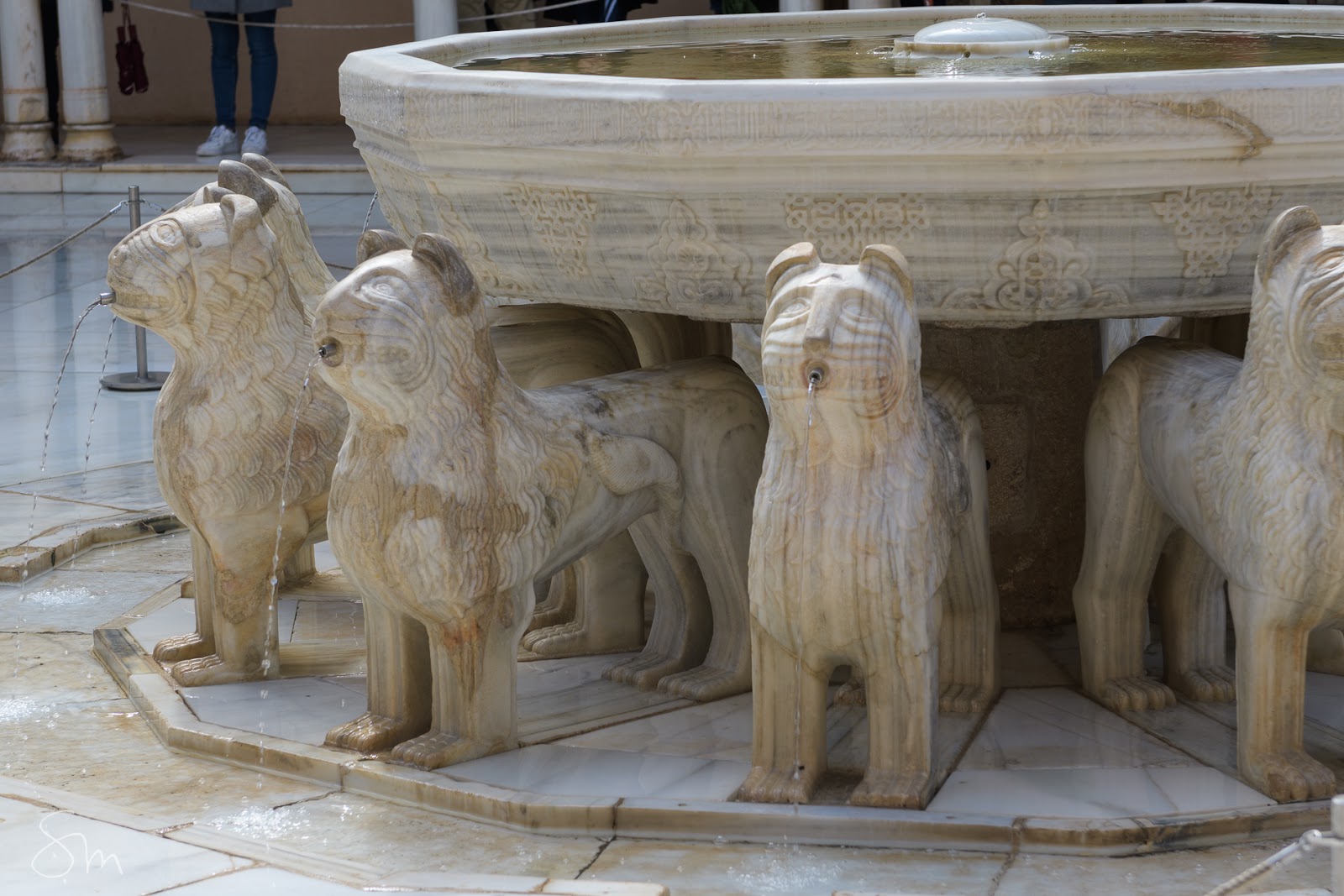
the famous Court of the Lions


delicate plaster elements


She, too, was waiting out the rain under cover. 


The courtyard of the Parador of Granada, an old Franciscan monastery.


Finally the sun came out and we found a dry spot. 


 Panorama of the Alhambra from the Albaicin quarter on the opposite hill. 

 street musician at Granada Cathedral 


... the weather is improving ...


Marbella beach at the end of February


 the village of Benahavís up in the mountains north of Marbella


 A lounge at Finca Cortesin, a very nice hotel a bit off from the coast


Some colour, even in winter


and what nasty creature is this? Ceiba speciosa, the "Silk floss tree".