Showing posts with label tanzania. Show all posts

Sunday, 24 December 2017

A sequel ..


My second Africa book is out! 


240 pages with large format pictures from the safari in the northern Serengeti in August where we watched the spectacular Great Migration. 

We stayed at two different camps: Olakira and Nomad Lamai Serengeti. Both are close to the Kogatende Airstrip, but in very different settings. Olakira is very basic and rustic, sturdy army tents with bucket showers, in the plains on the Mara river. The tents move twice a year with the migration.  Nomad Lamai is very different, very luxurious in solid huts, constructed unobtrusively hidden in the kopjes of the Lamai wedge with a wide view over the plains. A hard copy of my book graces the coffee table there in the lodge's lounge :)! 


The Great Migration - Northern Serengeti


As with the last book about Tarangire, you can browse the photographs for free. Clicking on the link above will take you to the Blurb-website, where you can preview all the pages in large format on your screen.

Enjoy!


Have a nice Christmas holiday -  see you next year! 


Friday, 6 October 2017

In eigener Sache ....


I have produced a beautiful hardcover coffee table book from my photo safari in Tarangire !
It is my first "proper" book, it was fun creating and I am very proud of it. I have used the publishing company Blurb.com - they seem to produce the best quality photobooks with true colours and a choice of papers with the option of linen hardcovers and dust jackets which look great.

You can find it here ! It has more images than my Tarangire posts. If you just want to browse the pictures, please use the link below and click on preview. A list of animal names in English and Latin is in the back of the pages. All the images are visible for free : 

   "Tarangire"

If you order a hardcover, I will get a (tiny) profit. 
I am also open for any suggestions on improvement! 

Thanks!

Sibylle


Tuesday, 12 September 2017

Tanzanian Safari - A Bush Walk in Tarangire NP


On a normal photo safari one would usually not venture out into the bush on foot but strictly stay on the vehicle or in the tents and on pathways in the camp and follow all the rules set by the guides. Very few camps offer walks - we had done one in Kenya ten years ago where we saw insects, beetles and spiders, plants and their medicinal uses and similar . It was interesting though not comparable to a game drive. Olivers Camp in Tarangire NP offered a guided bush walk with a ranger and guard of a very different, very rewarding kind. Somehow very unique with a primordial feeling - just us and the bush, on eye-level with the animals, no protection (except a guard with a gun which he said he has never needed to make use of so far). 
I took two cameras with me and chose something reasonably light-weight: the D810 with a 20mm prime lens and the D500 with the ultra-light 300 mm f4 prime.
We set out from the camp early in the morning with our guide.  It became clear right away that he had grown up in the bush, knew all the noises, smells, the animals and their behaviour and reactions to threats, their capabilities of vision, hearing and smell, the tracks. He tested the wind direction, sniffed the scents. We went down from the camp across the river and after an hour of walking sat down on the ground on the other side a little elevated behind bushes to watch the river and the animals that were coming down to the water for drinking. Zebras, wildebeest, impala, buffalo, occasionally an elephant, moved in and out of the picture, a fish eagle was sitting high up on a tree watching over the peaceful valley.  


Buffalo in the distance


quite close - the wind was blowing favourably in our direction


After a while we continued our walk 

Waterbuck - We are quite an attraction - 

The zebra seem to wonder why we walk ...


Termite tracks on the bark of this tree.

..and found a place behind a fallen tree just above a mudhole.


... and here I don't have my usual pictures to show. I could not take any, just one silent iphone photo. This buffalo came slowly trundling along the track, totally relaxed, snorted and grunted in the water and lay down to take a thorough mudbath. He was so close, we did not dare breathe let alone take a picture with a loud shutter noise! So we quickly got this silent shot with a phone to not disturb him. Apparently their eyesight is abominable... 


Another buffalo followed the first, then a family of elephants came out of the bush and continued along the muddy path, but once they were all gone, we crossed over the muddy stretch and went back to the camp.


Saturday, 2 September 2017

Tanzanian Safari : Northern Serengeti - the Kopjes


In the Northern part of the Serengeti close to the Kenyan border the area becomes varied and rocky. Millenia old round granite and gneiss boulders dot the unique plains. These rock formations offer living habitats, protection and look-out points for various species of animals adapted to these conditions  that are rarely seen in the dusty desert areas further south. In the early mornings many boulders are occupied. 

 See the little lonely rock hyrax?

There are more ...


The closest living relatives to these pretty little furry things are elephants - deduced from skeletal anomalies.


a martial eagle has seen them, too


This huge boulder is look-out point for klipspringers, a small sturdy antelope with adapted feet to climb steep rocks.


Banded Mongoose


 Oribi, another tiny antelope, that prefer the grassy areas between the kopjes.


Rainbow or common Agama (Agama agama), drying his nails. He also goes by the nickname "Peter Parker"


Cats liks this area, too. The boulders are ideal vantage points for cats on the look-out. During the heat of the day they retire to the shade in the crevices of the rocks. In the evening they climb up on the heated stones for a good overview of their territory.


see the lion brothers?  


Are they both sticking their tongue out at me??


Leopard mum had left her two cubs playing on the rocks, quite undisturbed by us watching. 


 Well-bred -  yawning with a paw over his mouth! 


 mother is posing as sunbathing sphinx 


Monday, 28 August 2017

Tanzanian Safari : The Great Migration and a Crossing (II)


We had seen a safe crossing through the Mara river of a huge herd of wildebeest and zebra with thousands of animals on our first day in the area. 
Most people, however,  yearn for the more gruesome pictures of the crossings, that make it into the magazines and films: of crocodiles preying on a stumbling wildebeest in the water, of broken limbs and orphaned wildebeest babies. They try to glimpse some of nature's less happy moments and wonder why they come back to camp in the evening a little subdued  ... watching and hearing the real thing happening a few meters away is very different from looking at pictures in wildlife books and watching TV documentaries from the comfort of a sofa. 

Those crueller aspects of the Great Migration shone up unexpectedly one evening when we were having a nice relaxing sun downer on the river bank over the peacefully flowing river. Or so we thought ... 


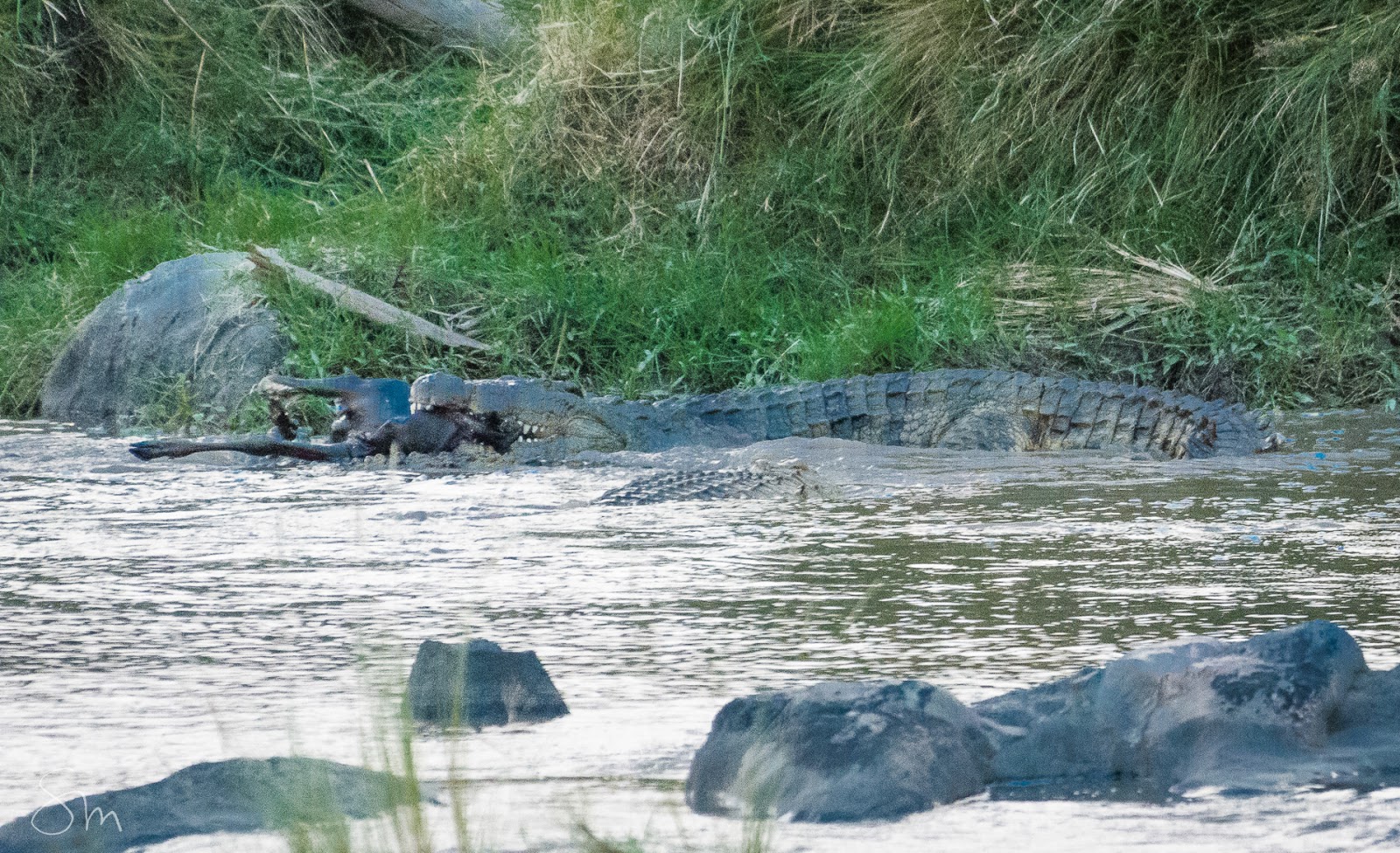
Suddenly, I heard a loud "Mooh!", a splashing noise, saw something fly through the air. I ran back to the car to grab my camera which I had left behind as it was getting dark already, set focus on the far side of the river bank and watched the drama unfold. Most of the action was happening under water or in a wild misty spray with occasional gruesome images popping up like in a horror movie.

The following pictures are high-ISO and a bit noisy as I needed a fast shutter-speed.  


Several crocs fought about the wildebeest to tear it apart. Eating for them is an exercise in team work, as their teeth are not made for chewing but for tearing only. The bits are swallowed whole.


While tearing at the prey, crocs make a rolling motion called the "death roll" which you can see in the next pictures when their white bellies come up. They use this motion to twist off pieces because their jaws are not made for cutting and shearing. 


that's the stomach.


Another dramatic spectacle with a huge massacre of dead wildebeest we found the next day a bit downstream. 
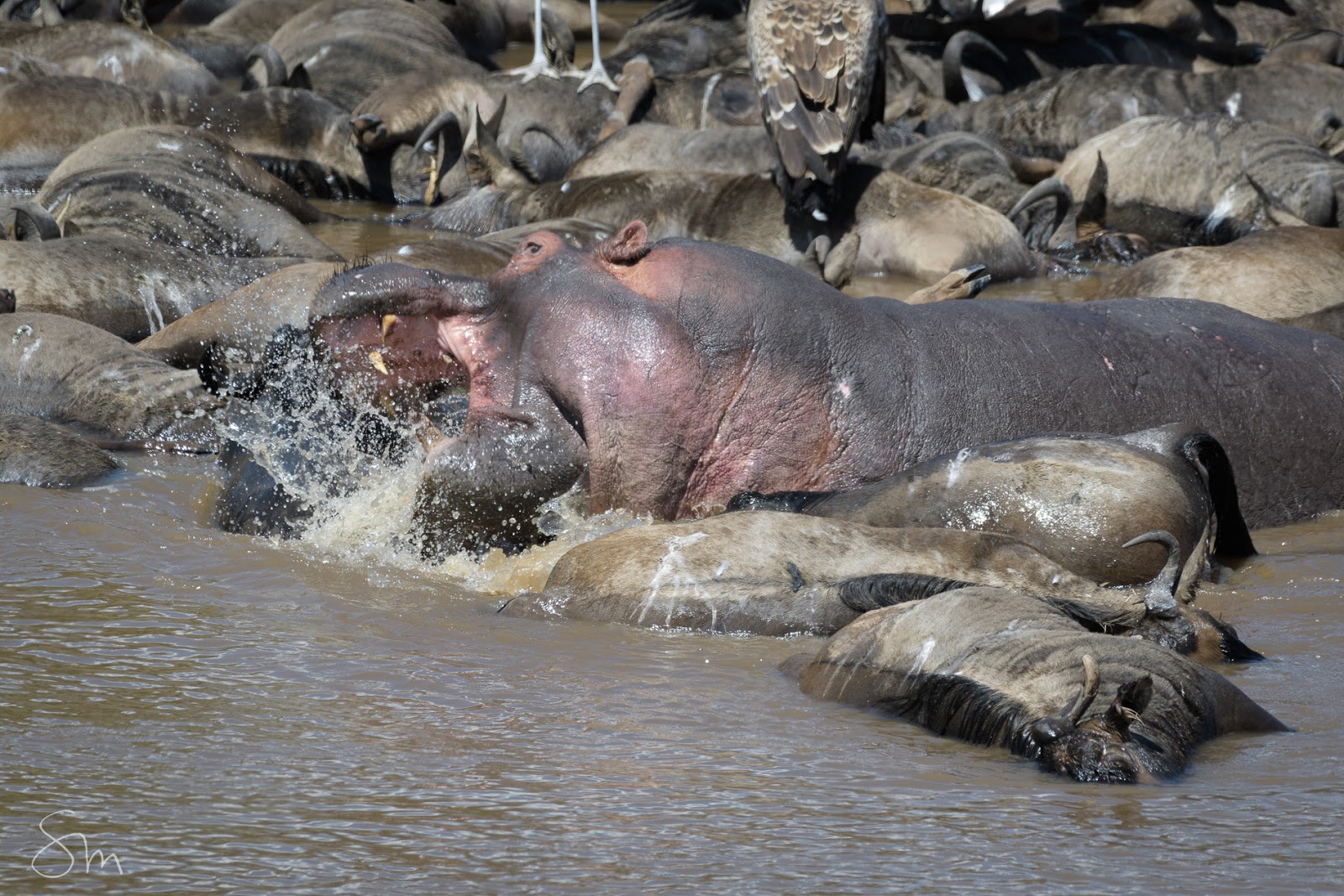
Here wildebeest had tried to cross the river where the bank on the far side was too steep. They could not get back on land and many did not survive the stampede. The bodies were washed ashore where the river was shallow and they were creating a blockade, where a cloud of vultures was circling over. 


A furious hippo came along trying to push his way through the dead bodies. He had not realized what had happened and that all these animals were dead. He started to threaten showing his teeth and even took one whole wildebeest carcass in his huge mouth, shoving through the carnage and making way, obviously angry that his river was thus polluted. 


Out of my Way! 


A few days later heavy rainfall washed the river clean and all the debris down to Lake Victoria. Which by the way provides drinking water for all surrounding countries and - with the river Nile passing through - even up as far as Egypt. 
In spite of all these victims and their often quite stupid suicidal behaviour, wildebeest are a very successful animal species in numbers. Not many of their offspring are lost and their numbers in Serengeti exceed 1.3 mio animals.  


Here I have produced some abstracts from panning exercides inspired by timeless cave drawings.